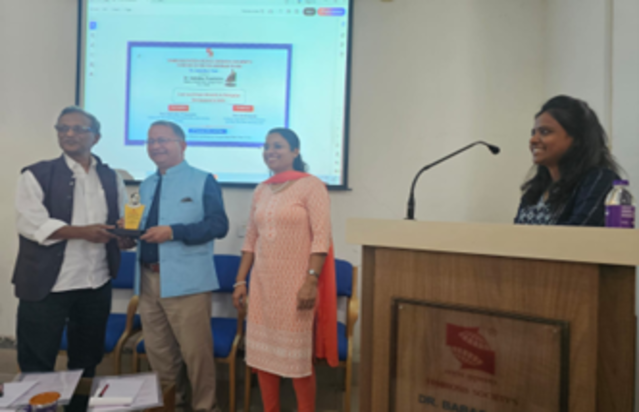
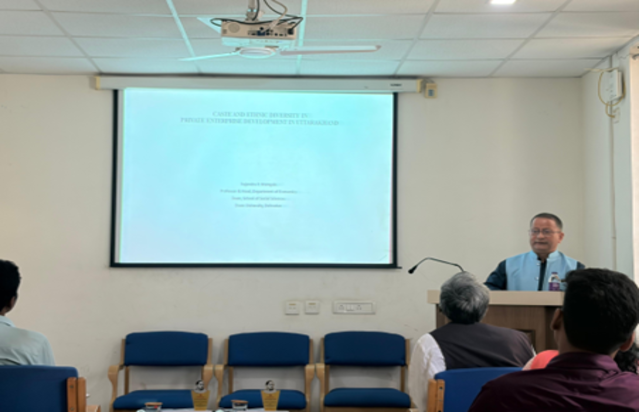
On January 17th, 2026, the Symbiosis Centre for Ambedkar Studies hosted a comprehensive guest lecture titled "Caste and Ethnic Diversity in Private Enterprise Development". The program, which was conducted in a hybrid mode, began with an opening by Deepali Kamble. The formal proceedings included a series of honours, during which Prof. Harsh Jagzap facilitated the guest speaker, Prof. Rajendra P. Mamgain, and Hemangi Kadlak subsequently facilitated Prof. Harsh Jagzap. The lecture aimed to dissect the intersectional challenges of geography, caste, and gender in the context of India’s economic development, with a specific focus on the state of Uttarakhand.
Prof. Mamgain, the Dean of the School of Social Sciences at Doon University, opened the session by discussing the structural transformation of Uttarakhand since its formation in 2000. He noted that while the state has achieved impressive growth tripling its GSDP and per capita income and ranking first among top SDG performers in 2025 deep regional disparities remain. The hill regions, which account for 86% of the state's land, contribute less than 27% of the GSDP. This economic imbalance has led to the phenomenon of "ghost villages," where entire settlements are abandoned due to a lack of local jobs and climate stress. Prof. Mamgain highlighted that while manufacturing is a high-growth sector that contributes 37% to the GSDP, the majority of the hill workforce is stuck in low-income agriculture. To bridge these gaps, he introduced the "3A" framework, stressing that opportunities must be Accessible, Affordable, and Available.
The discussion then shifted to the social and gender dimensions of education and labour. Prof. Mamgain presented data showing that, while the Gender Parity Index in higher education varies, significant gaps persist at prestigious Institutes of National Importance, where enrollment for marginalised groups remains lower than in state universities. He pointed out that Scheduled Castes (SC) face particularly high dropout rates, and women across all groups especially within the OBC category experience lower labour participation rates. Currently, women's workforce participation stands at only 24%, and Prof. Mamgain argued that high participation rates among certain groups, such as Scheduled Tribes (ST), do not always equate to prosperity but often reflect a lack of choice.
In the final segment of the report, Prof. Mamgain analysed enterprise ownership trends, revealing that the share of private enterprises owned by SC and ST individuals is disproportionately low relative to their population share. He identified that OBCs are often concentrated in trading, while SCs are frequently found in "service castes," earning significantly less than salaried employees or their upper-caste counterparts. These disparities are fueled by discriminatory processes, including entry barriers to business, a lack of social networks, and difficulty in securing credit or initial orders. He concluded that economic support alone is insufficient; social and political support, alongside mentorship and training, are vital for true empowerment. Following the lecture, Prof. Harsh Jagzap concluded the session by summarising the diverse viewpoints and offering a token of appreciation to both Prof. Mamgain and himself, marking the end of the program. The session was concluded by Prof. Harsh Jagzap, who offered a summary of the diverse discussions and a difference of opinion on certain political representations. The program finished with a token of appreciation presented to both Prof. Mamgain and Prof. Jagzap.


